Start with the decision, not the device
Write down the management or research decision the survey will inform. Searching for a rarely recorded species, estimating site use and comparing management areas demand different sampling designs. A convenient camera position is not necessarily a representative one. Define the sampling frame and placement rules before selecting the platform that will process the files.
Ask who will use the results and what uncertainty they can tolerate. A ranger team may need a rapidly reviewed alert, while a programme evaluator needs reproducible comparisons across seasons. These workflows can share devices but require different review deadlines and evidence standards. Establish those expectations early so that a field team is not later asked to produce an abundance estimate from an opportunistic presence survey.
Secure permission and reduce disturbance
Obtain the relevant land access, research and protected-area permissions. Involve local partners and communities in planning, particularly where sensors may record people or culturally sensitive activity. Consent and authorisation are not solved by removing names from a spreadsheet. Teams should understand who controls the collected material, who can access it and how concerns can be raised.
Choose installations that minimise disturbance and comply with site rules. Avoid publishing nest sites, den locations or predictable routes used by vulnerable species. Consider whether a visible device creates theft risks or draws attention to a sensitive area. Physical security is important, but it should not involve unsafe attachments or changes that damage habitat.
Pilot the complete observation chain
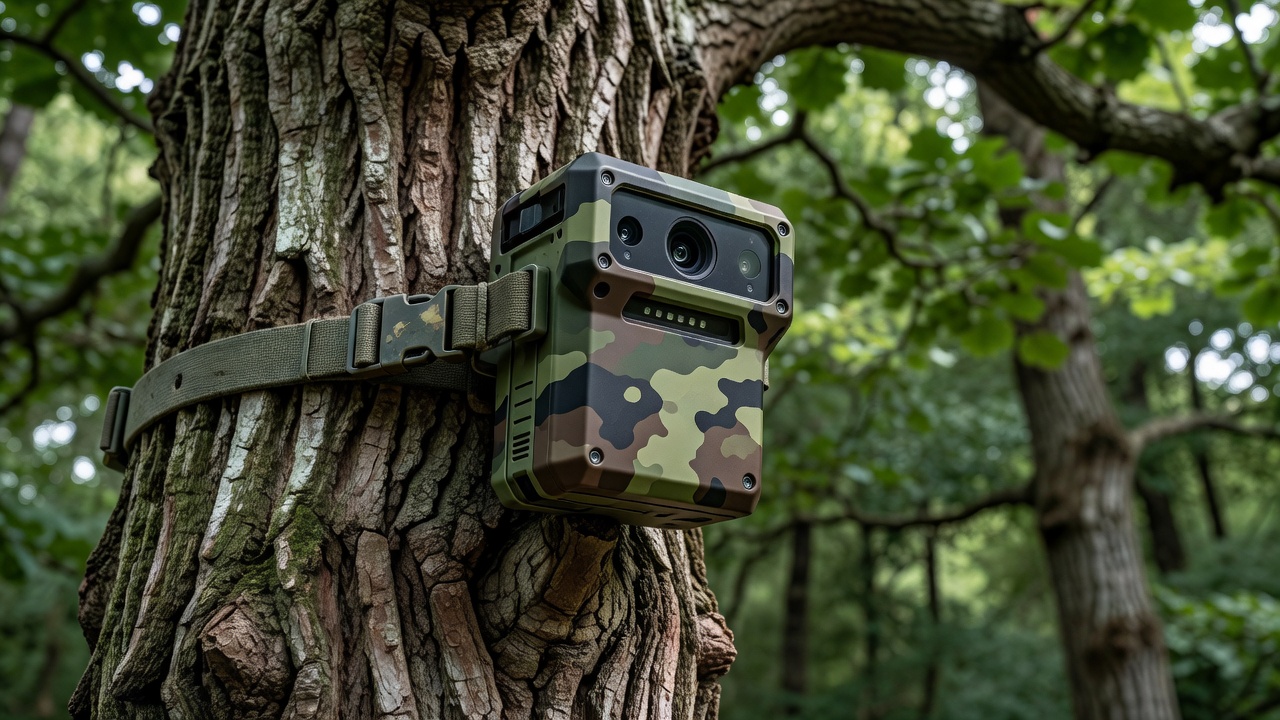
Run a small pilot that includes installation, data collection, transfer, AI processing, review and export. Test night imagery, rain, moving vegetation and the expected range of animal sizes. For audio recorders, examine wind, insects, overlapping calls and the chosen recording schedule. Device specifications alone cannot show whether the full workflow will produce useful evidence in local conditions.
Check sensor clocks, time zones, daylight-saving settings and file naming. Record firmware, sensitivity, burst length and trigger delay. If several devices use different configurations, either standardise them or document why the differences are needed. A clock error that appears trivial in the field can later prevent reliable matching of paired cameras or create misleading activity patterns.
OBSERVATION
A camera contains no target-species images after several weeks.
RESPONSIBLE INFERENCE
Check installation, uptime and detection conditions before treating the empty record as ecological evidence.
Build an effort log that survives staff changes
Give each deployment a stable identifier distinct from the device serial number. A device may be moved between stations, while a station may receive a replacement device. Record installation and recovery times, maintenance visits, battery changes, card swaps, settings and any evidence of failure. Link the log to files without exposing precise locations in public exports.
When failure time is uncertain, retain that uncertainty. A card recovered empty does not prove the camera worked throughout the interval. Define a consistent rule for estimating usable effort and flag ambiguous periods. Preserve the original field notes even after a cleaned dataset is produced, so a later analyst can understand the assumptions rather than inherit an unexplained camera-day total.
Plan power, storage and connectivity honestly
Estimate energy and storage needs using realistic triggering or recording rates, not only the manufacturer’s ideal conditions. Cold, humidity and frequent false triggers can change battery life. Solar charging may be unsuitable under dense canopy. Remote connectivity can shorten alert delays, but it adds coverage, cost and security dependencies that a simple offline workflow may avoid.
Platforms such as SMART and EarthRanger support conservation operations and information workflows. Their suitability depends on the deployment context, integration requirements and staff capacity. For acoustic work, Open Acoustic Devices provides documentation for AudioMoth hardware. None of these resources replaces a local pilot, maintenance plan or data-access agreement.
| Risk | Practical check | Evidence to retain |
|---|---|---|
| Power loss | Test realistic duty cycles | Battery and service log |
| False triggers | Inspect vegetation and exposure | Settings and sample frames |
| Clock drift | Compare clocks at service visits | Recorded offset and correction rule |
| Data loss | Verify transfers before reuse | File manifest and checksums |
Recover evidence, not just files
Copy data into a controlled archive, verify transfer integrity and maintain an independent backup before cards are reused. Keep original files read-only where feasible. Link processing outputs to stable source identifiers so corrected labels do not become detached from images. Record what was excluded and why, including corrupt files and periods affected by malfunction.
Finally, budget for people. Field visits, expert review, equipment repairs and long-term storage are real monitoring costs. A system that is inexpensive to purchase but impossible to maintain can produce a convincing pilot and a broken time series. Design the deployment that the team can sustain, then document its limits clearly enough for someone else to evaluate.